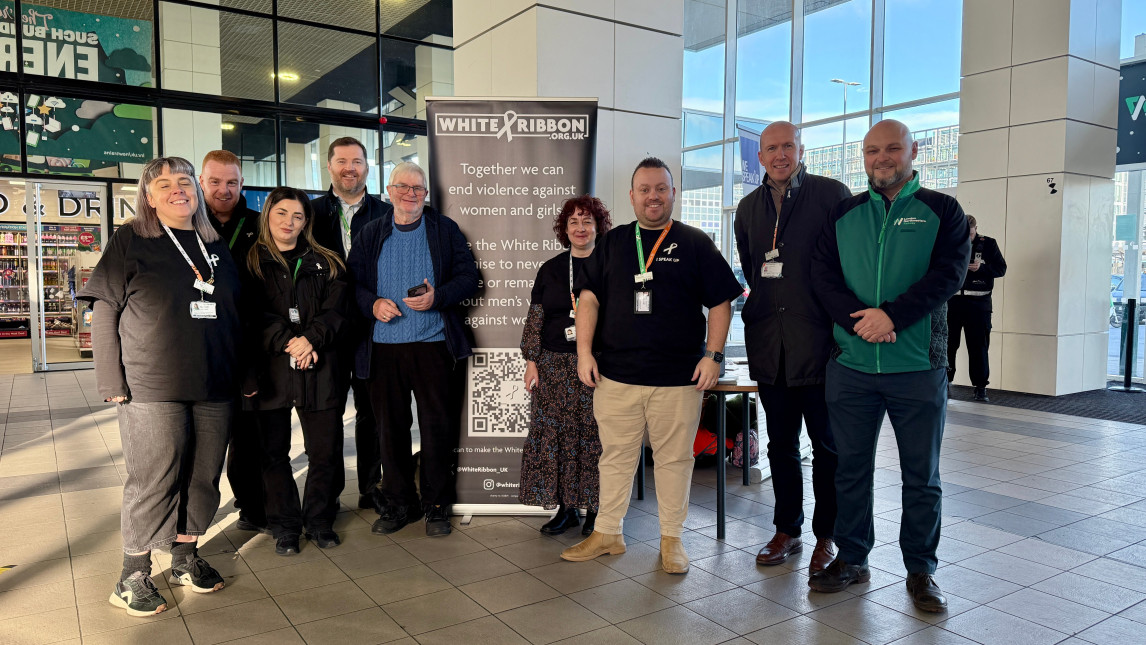
Last November, colleagues stood at stations across our network with white ribbons and an open invitation to talk. Some conversations were gentle, some were harder; regardless of their gravity, all of them mattered.
That is what this work looks like in practice.
Not a policy document, not a press release, but people choosing to show up, to speak, and to make the promise that violence against women and girls will not be something they stay silent about.
Today, that commitment has a stronger national backbone behind it.
A new Violence and Intimidation Against Women and Girls (VIAWG) strategy for 2026–2028 has been jointly developed and launched by Rail Delivery Group, British Transport Police, Network Rail, the Department for Transport, DFTO, Transport for London, Transport for Wales, Transport Scotland, and Transport Focus — a whole-industry commitment to make Britain's railways safer for every woman and girl who travels or works on them. We are proud to stand behind it. And we want to be honest about why it matters.
The numbers are not distant statistics
The scale of the problem is well-documented. One in four women in England and Wales will experience domestic abuse in her lifetime, according to Refuge. Three in five women say they have experienced sexual harassment, bullying or verbal abuse at work — rising to almost two in three among women aged 25 to 34 — according to a TUC poll . And research published by the Department for Transport in February 2026 found a stark gender gap in how safe people feel: just 14% of women feel very safe on public transport, compared to 24% of men, with young women feeling especially unsafe.
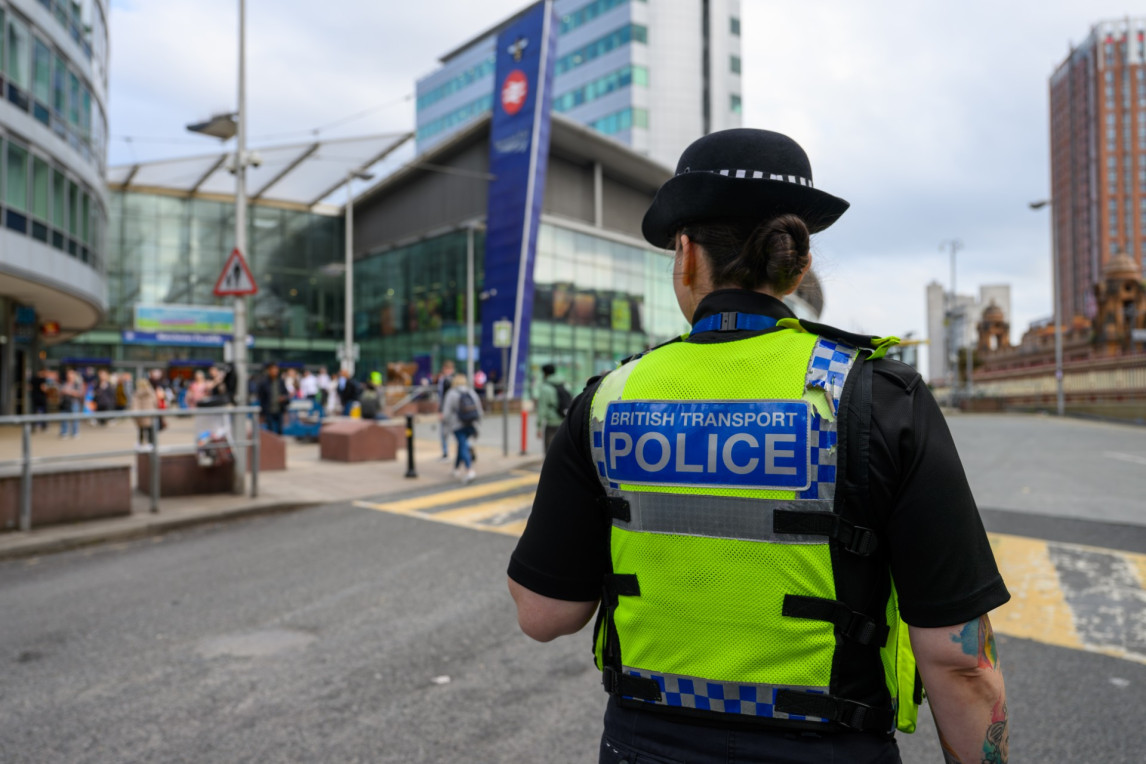
The picture on our railways specifically is improving, but it needs to improve faster. British Transport Police currently solve 22% of rape cases and 18.5% of sexual offences on the rail network, outperforming the national police average of 4.2%. And a 24% increase in reporting over the past year suggests more people are finding the confidence to come forward. Both figures matter — because better reporting and better outcomes only happen when people trust the system they're reporting to.
These are not abstract figures. They are people on our trains, people on our platforms, people in our teams.
What the new strategy commits to
The 2026–2028 strategy sets out measurable, trackable commitments across the entire rail industry: mandatory sexual harassment training for all customer-facing staff, body-worn video for frontline colleagues, passenger focus groups co-designed with women and girls, and a discreet reporting app for anyone who experiences an incident on the network.
It adopts the same 4P framework — Prevent, Protect, Pursue, Prepare — used to tackle serious organised crime. That is not accidental. It reflects how seriously the industry is taking this.
Where we are in our own journey
For London Northwestern Railway, this work did not begin today. Two years ago, we made a formal commitment through our White Ribbon Accreditation — a three-year action plan with real deliverables, overseen by a Steering Committee that spans our organisation.
Year one was about building the structure. Year two — where we are now — has been about using it. Active Bystander Training rolled out to colleagues. Sixteen Days of Action at stations last November. Customer-facing events asking people to make the White Ribbon Promise. Internal work on language, policy and culture, because what we say outside has to reflect what we do inside.
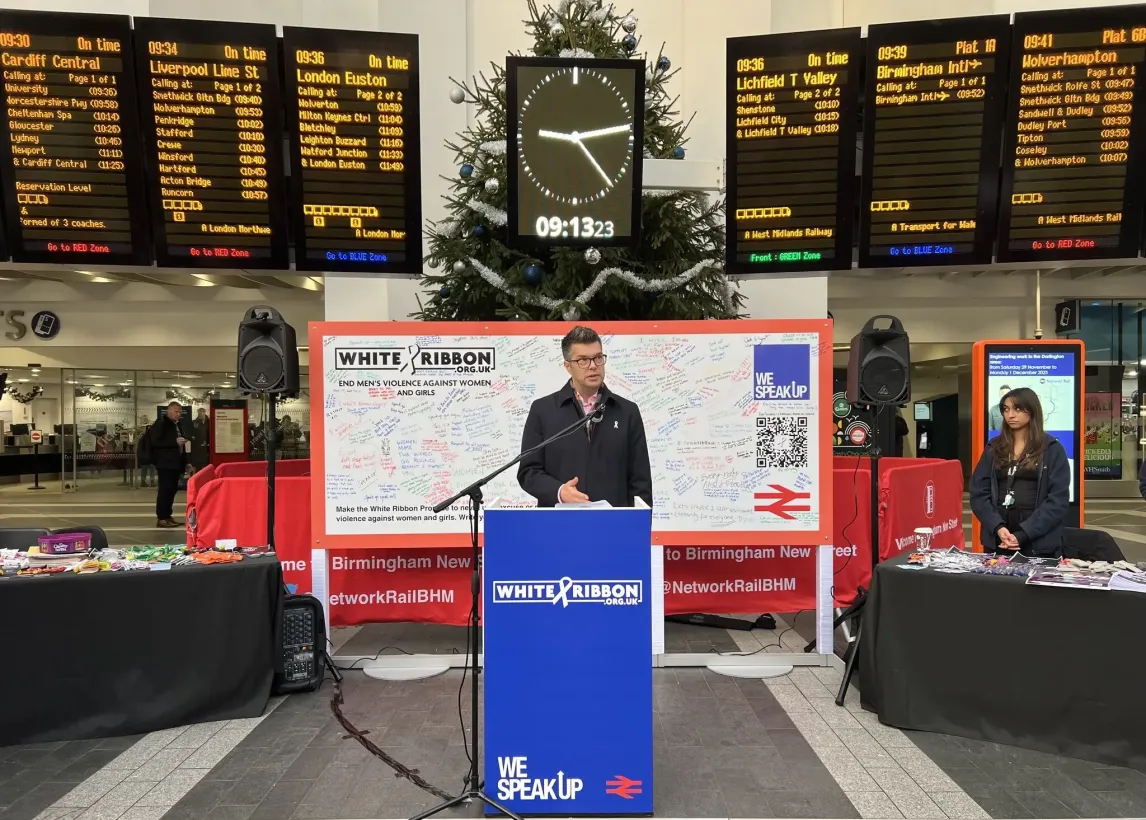
Our Customer Experience Director, Jonny Wiseman, put it plainly when he spoke at a White Ribbon Day event held by Network Rail in Birmingham’s New Street Station:
"As a leader and as a colleague I am determined that we will create workplaces where female colleagues feel safe, respected and included at all times. And as a father to two young daughters, I am passionate about creating a world where my children do not need to feel afraid."
That is what accreditation means in practice. Not a badge, but a direction of travel.
What comes next
Change does not happen in a single strategy launch, just as it did not happen in a single White Ribbon Day. It grows from the conversations colleagues were willing to have at pledge stands. From the training that changes how someone responds when they witness something uncomfortable. From the person who decides to text 61016 rather than look away.
Our network carries thousands of people every day, and behind every journey is a person who deserves to feel safe — not just technically, but genuinely. That is the standard this new industry strategy is asking us to meet.
We intend to meet it.
If something doesn't feel right while you're travelling with us, please speak to a member of staff or text British Transport Police on 61016. In an emergency, call 999.
To make the White Ribbon Promise, visit whiteribbon.org.uk
Sources: Refuge: Facts and Statistics
| Department for Transport: Personal Safety on Transport, February 2026
| BTP/RDG VIAWG Strategy 2026–2028
| 'We Speak Up': LNR White Ribbon Day 2025